
1998-D: A Common Date with an Uncommon Twist
At first glance, the 1998-D Lincoln cent appears to be a mass-produced object possessing predictable market characteristics.
The vast majority don’t exceed the face 1998 D penny value, remaining in active circulation across the country.
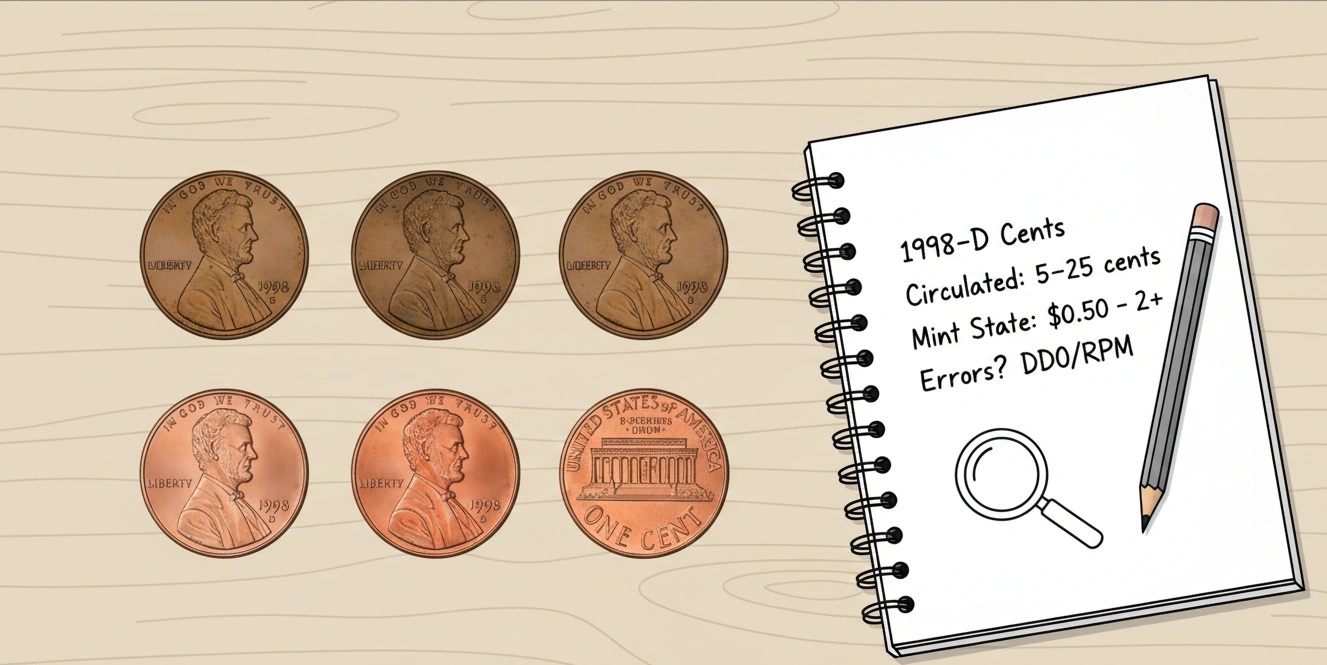
Market premiums are driven by two factors: top-tier preservation and specific reverse die errors.
Composition: 99,2% zinc core, 0,8% copper plating
Weight: 2,50 g
Dimensions: 19,05 mm diameter, 1,52 mm thickness
Wide AM Reverse Variety
The central numismatic interest of 1998 centers on an error involving the use of reverse dies.
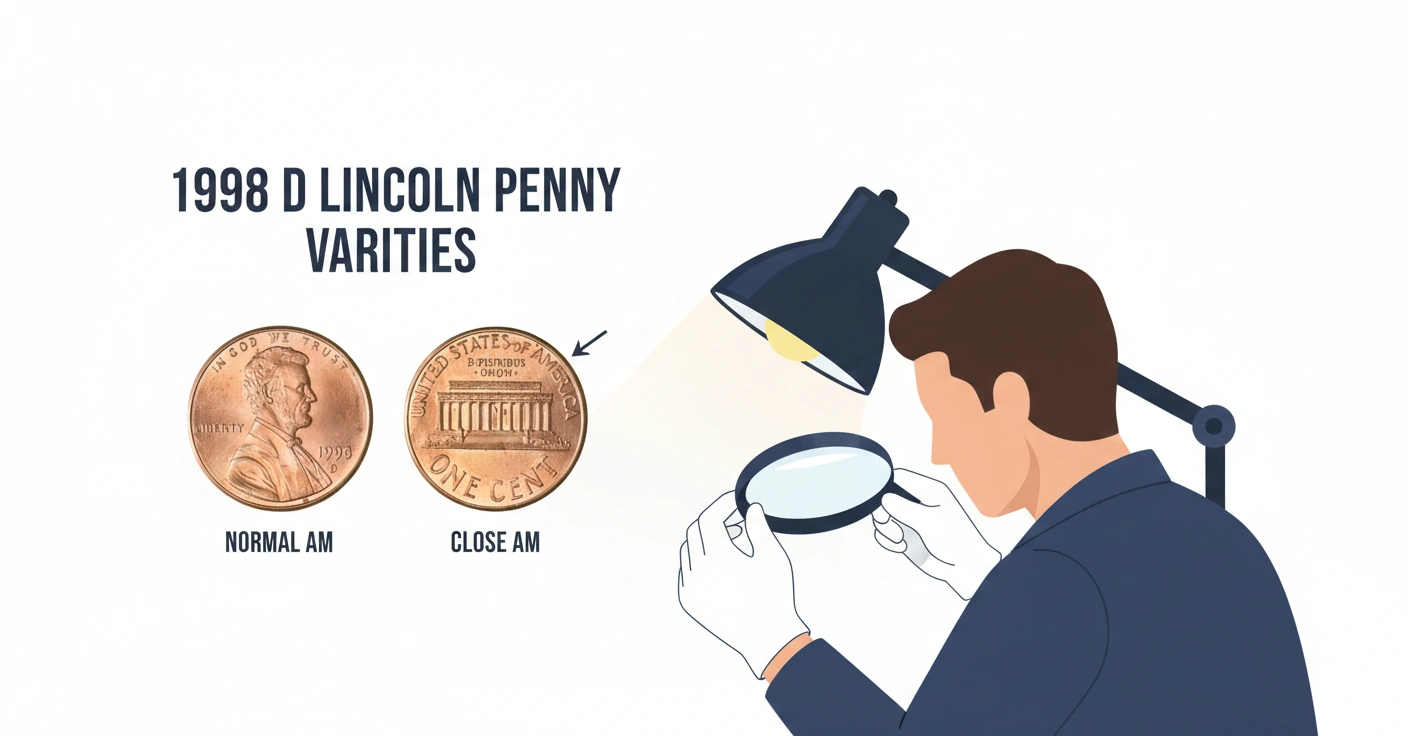
Standard 1998 business strikes utilize a die featuring closely spaced letters A and M in the word AMERICA (Close AM).
However, a portion of the mintage features a die intended for Proof quality coins, where the letters A and M are separated by a noticeable gap (Wide AM).
To identify a Wide AM specimen, the following criteria are applied:
The distance between the bases of letters A and M is significantly wider than in the standard version
The designer's initials (FG) on the reverse are shifted closer to the Lincoln Memorial
The details of the central building's steps possess sharper outlines
This variety occurs much less frequently than the standard strike, resulting in a significant price premium.
Mintage Statistics and Market Availability
The Denver Mint provided a substantial emission volume in 1998, exceeding the figures of many previous years.
High survival rates for coins in conditions below MS66 make them readily available for general collecting.
Mint Facility | Mint Mark | Mintage | Rarity Category |
Philadelphia | None | 5,047,730,000 | Common |
Denver | D | 5,225,200,000 | Common |
Philadelphia | Wide AM | Unknown | Scarce |
Despite the lack of precise data regarding the number of Wide AM specimens for Denver, confirmed finds are classified as extremely rare events.
Value Categories and Grading
The value of a 1998-D coin depends directly on the preservation of the original red luster (Red designation).
Specimens demonstrating darkening or traces of corrosion are appraised at minimal market rates.
Grade | Standard 1991-D | Wide AM (P-issue) | Market Trend |
MS65 RD | $2 | $150 | Stable |
MS66 RD | $12 | $350 | Moderate Growth |
MS67 RD | $45 | $1,200 | High Demand |
MS68 RD | $350+ | $3,000+ | Scarcity |
Auction Records and Market Dynamics
Maximum prices are recorded when realizing coins in MS68 grade and above possessing flawless surfaces.
In 2015, a 1998-D specimen in PCGS MS68 RD condition was realized at auction for $375.
By 2023, the value of coins in similar grades rose to $520, demonstrating a 38% increase over eight years.
For rare Philadelphia Wide AM varieties, records exceed the $5,000 mark for specimens in MS67 condition.
The total capitalization of certified 1998 red cents increases by 4-5% annually, driven by the completion of Registry Sets.
PCGS and NGC Data
Studying population reports allows for an objective assessment of the difficulty involved in finding a perfect coin.
For the 1998-D issue in MS67 RD grade, over 2,000 specimens are registered, confirming its status as a relatively accessible coin.
A sharp drop in the number of surviving coins is observed when moving to the MS68 RD grade, where fewer than 150 confirmed units are listed.
An MS69 state for this year remains virtually unattainable due to the softness of the copper coating, which absorbs any damage during contact with other coins in mint bags.
Identification Procedure for Rare Conditions
A professional inspection of the 1998-D requires the use of a microscope to exclude hidden plating defects.
The galvanic process applied in the late nineties often left microscopic voids under the copper layer.
Determining the reverse type by measuring the distance between the letters A and M
Verifying the condition of the FG initials for sharp relief
Searching for "carbon spots" reducing the coin grade to MS64 or below
Analyzing the brightness of the mint luster on the fields surrounding Lincoln's portrait
Checking the coin rim for nicks sustained during transportation
Quality Criteria and Defect Lists
A high-quality specimen must meet a series of strict visual parameters.
Investment collection selection criteria:
Uniform copper-red color across the entire surface
Complete absence of plating blisters
Deep striking of the central Memorial columns
Absence of fingerprints initiating long-term corrosion
High detailing of the hair in the obverse portrait section
Preservation of mirror-like luster in hard-to-reach areas of the relief
Typical technical problems of the issue:
Gas bubbles trapped under the copper layer
Die wear traces appearing as radial lines
Mechanical damage from counting machines
Loss of luster due to improper storage conditions
Comparison with Neighboring Years
When compared to the 1997-D and 1999-D, the 1998 issue stands out specifically due to the Wide AM variety.
The 1997-D is considered easier to find in high grades due to better quality control of the planchets.
The 1999-D also possesses Wide AM varieties, but their market value is often higher due to a smaller number of discovered specimens.
Statistically, 1998 serves as a baseline for collectors beginning the study of modern Lincoln varieties.
Investment Risks and Storage
The primary risk when working with zinc cents lies in their instability.
Moisture penetrating through micro-cracks in the copper triggers an irreversible zinc destruction process.
The use of airtight, PVC-free capsules is the only method for preserving a coin in Red grade.
The liquidity of MS67 grade coins remains stable, ensuring quick realization on specialized platforms.